Most cold emails fail before the reader gets to the offer. They ramble, they lead with the company instead of the problem, or they ask for a 30-minute call before earning ten seconds of attention. A framework doesn’t make you a better writer overnight, but it forces structure onto copy that would otherwise wander.
Here are four frameworks that consistently outperform generic templates, along with when to use each one.
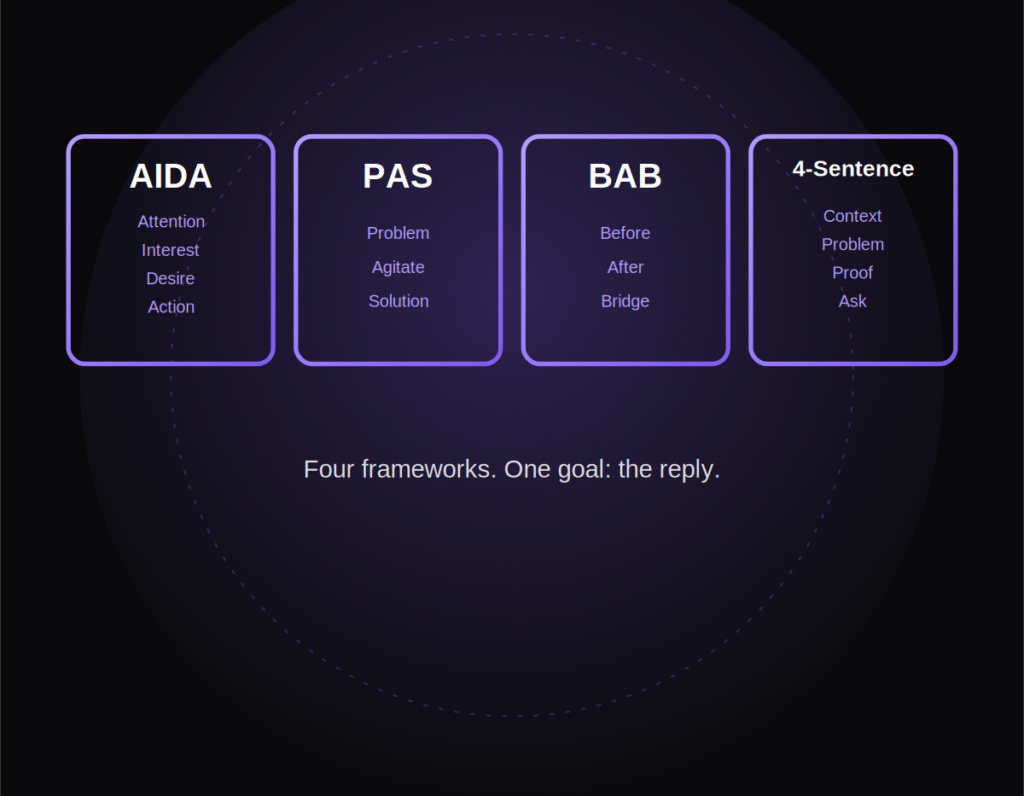
AIDA: Attention, Interest, Desire, Action
AIDA is the oldest framework in direct response copywriting, and it still works because it mirrors how attention actually moves through a message.
- Attention: Open with something specific to the reader, not a generic greeting. A relevant observation about their company works better than “Hope you’re doing well.”
- Interest: Connect that observation to a problem they likely have.
- Desire: Show, briefly, what solving that problem looks like.
- Action: Ask for one small, low-friction next step.
Example:
Subject: Noticed [Company]’s recent hiring push in sales
Hi [Name], saw [Company] added six SDRs this quarter. Usually that means outbound volume is about to spike, and deliverability becomes the bottleneck nobody planned for.
We helped [similar company] scale from 200 to 2,000 emails a day without their reply rate dropping.
Worth a 10-minute look at your current setup?
AIDA works best for cold outreach to a prospect who has a visible trigger event, a hire, a funding round, a product launch, something that signals timing.
PAS: Problem, Agitate, Solution
PAS skips attention-grabbing entirely and goes straight for the pain. It’s more direct than AIDA and works well when you’re confident the reader already knows they have the problem, they just haven’t prioritized fixing it.
- Problem: Name the specific issue.
- Agitate: Make the cost of ignoring it concrete.
- Solution: Present your offer as the fix.
Example:
Subject: Your emails might be landing in Promotions
Hi [Name], most B2B SaaS teams don’t realize their cold emails are hitting Gmail’s Promotions tab instead of the primary inbox until someone checks.
That means your SDR team could be sending hundreds of emails a week that prospects never see, while the team assumes low reply rates mean bad copy.
We run a free 10-minute audit that shows exactly where your emails are landing. Want me to check yours?
PAS is riskier than AIDA because agitation can come across as pushy if it’s too generic. It only works when the problem statement is specific enough that the reader recognizes themselves in it immediately.
BAB: Before, After, Bridge
BAB is the framework to use when you have a genuine before-and-after story to tell, typically in case-study-driven outreach or follow-up sequences rather than a cold first touch.
- Before: Describe the reader’s likely current state.
- After: Paint the outcome once the problem is solved.
- Bridge: Explain how they get from one to the other.
Example:
Subject: From 40% to 91% inbox placement
Hi [Name], most SaaS companies running cold outreach are stuck at [X]% inbox placement without knowing it, since open rates alone don’t tell you where emails are landing.
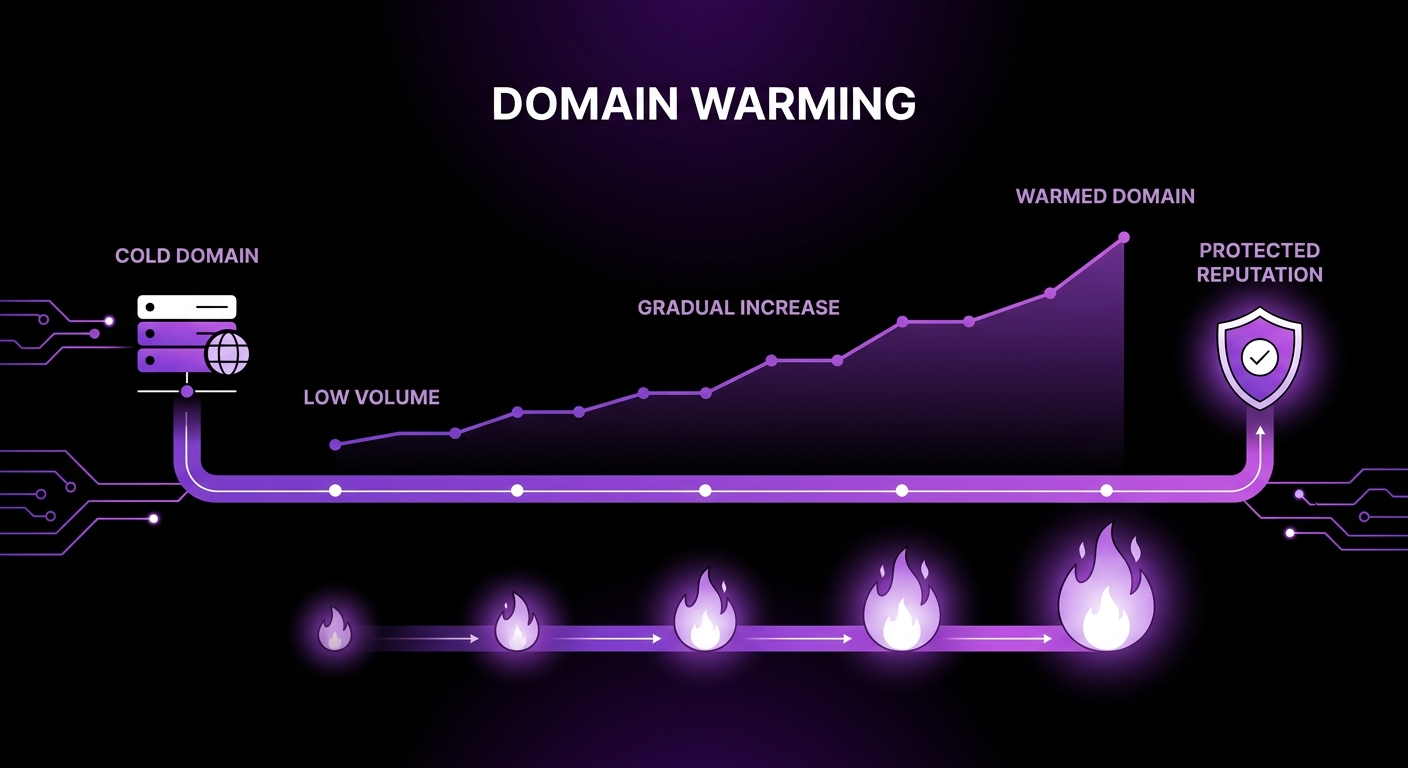
One of our clients went from [X]% to [Y]% placement in [N] weeks, just by fixing their SPF, DKIM, and DMARC setup and running a proper domain warm-up.
Happy to show you the exact before-and-after data if it’s useful.
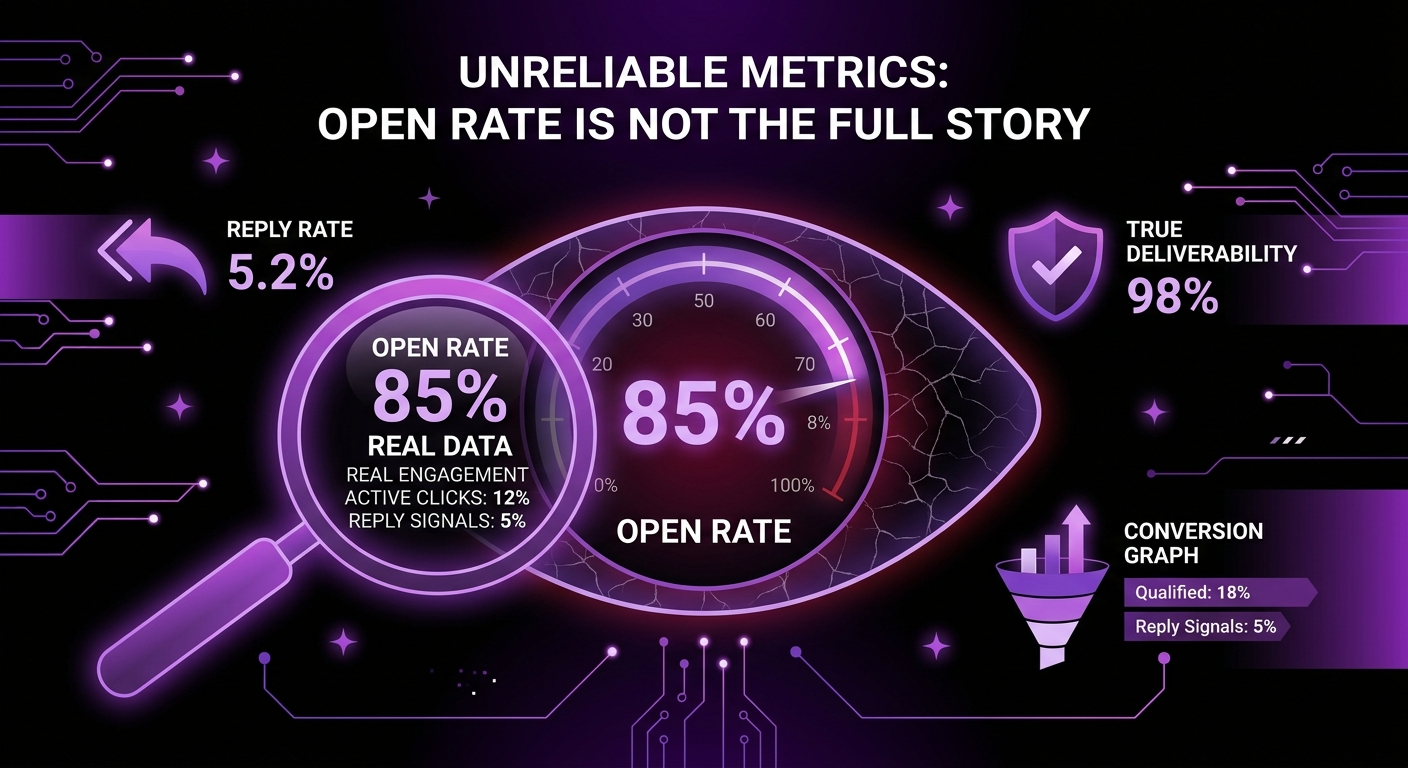
BAB is particularly effective in follow-ups two or three emails into a sequence, once you’ve established enough context for the transformation to feel credible rather than like a sales claim. To check whether a sequence is working, look at metrics that actually matter rather than open rate alone.
The Four-Sentence Cold Email
Not every situation calls for a full framework. When you’re reaching a busy executive, brevity itself is the strategy. The four-sentence structure is: context, problem, proof, ask.
Example:
Hi [Name], following up on [Company]’s Series B announcement. Fast-growing SaaS companies usually hit an outbound wall around this stage, where volume increases but deliverability wasn’t built to scale with it. We recently helped [similar company] handle a 5x volume increase without their placement rate dropping. Worth 10 minutes to see if the same applies to your setup?
This works because it respects the reader’s time explicitly through its format, not just its tone. Executives skim. A four-sentence email gets read in full more often than a well-crafted six-paragraph one.
Picking the right framework
There’s no single best framework, only the right one for the situation:
- AIDA for cold outreach with a clear trigger event
- PAS when the reader already feels the pain, you just need to name it precisely
- BAB for case-study-driven follow-ups where you have real before-and-after data
- Four-sentence for senior executives or anyone deep in a busy inbox
The framework gives you structure. The specificity, the trigger events, the real numbers, the details that prove you actually researched the prospect, is what makes any of them work. A perfectly structured email with generic filler still reads like a template.
Grow X writes and tests cold email copy as part of a full-service email marketing engagement, alongside deliverability setup, automation, and campaign management for B2B SaaS companies. If your reply rates have stalled, book a free consultation.