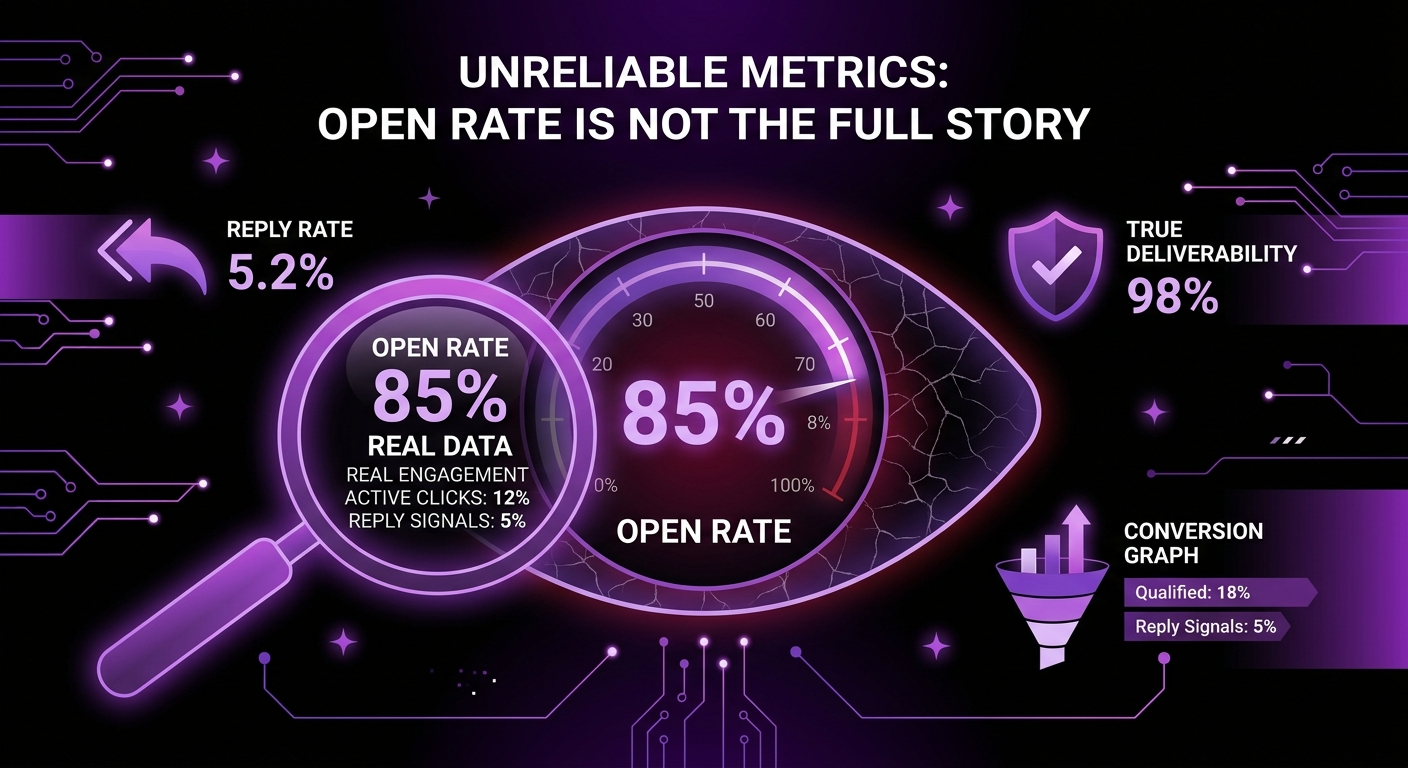
Most teams still open their campaign dashboard, check the open rate, and decide whether the campaign “worked.” That number has quietly become one of the least reliable metrics in email, and treating it as the headline stat leads to the wrong conclusions more often than not.
Here’s what changed, and what to actually watch instead.
Why open rate stopped being trustworthy
Open rate used to work reasonably well as a proxy for engagement. Apple’s Mail Privacy Protection changed that. Since its rollout, a large share of opens on iPhone and Mac are triggered automatically by Apple’s servers pre-loading the email, whether or not a human ever actually looked at it. Depending on your audience, this can inflate open rates significantly and unpredictably, making week-to-week comparisons unreliable.
The practical result: a campaign showing a 45% open rate might reflect real engagement, or might reflect a list heavy on Apple Mail users whose opens were never genuine. You can’t tell the difference from the number alone.
The metrics that still tell the truth
Reply rate
This is the single most reliable signal in cold outreach. A reply, positive or negative, means a real human read the email and decided it was worth responding to. Unlike opens, replies can’t be faked by a privacy proxy or a bot.
Track positive and negative replies separately. A high total reply rate with mostly “not interested” responses tells a different story than the same rate split toward genuine interest, and conflating the two hides what’s actually working.
Click-through rate, when relevant
For emails with a specific link, a case study, a booking page, a resource, click-through rate is a stronger signal than open rate because it requires an actual action, not just a background pixel load. It’s not universally applicable, a well-written cold email often doesn’t need a link at all, but when a link is part of the sequence, this is a metric worth tracking closely.
Bounce rate
This one matters for a different reason: it’s a direct signal about deliverability, not engagement. A bounce rate creeping above 2 to 3% usually points to list quality problems, and left unaddressed, it damages your sending domain’s reputation regardless of how good the copy is. A list that reaches spam traps can worsen the same reputation signals; our spam-trap prevention guide explains how to reduce that risk.
Spam complaint rate
Even a small number of spam complaints can meaningfully hurt inbox placement for everyone sending from that domain going forward. This metric matters less for optimizing individual campaigns and more as an early warning system. Any noticeable increase deserves investigation before it compounds.
Positive reply to meeting booked rate
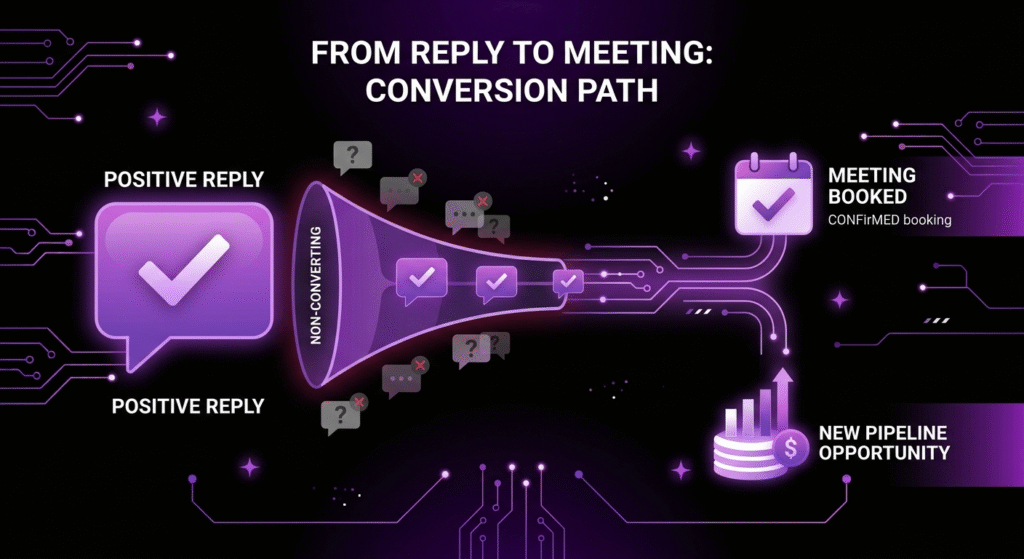
For teams measuring pipeline impact, not just engagement, this is the number that actually connects email performance to revenue. A sequence that generates lots of polite replies but few booked meetings has a conversion problem downstream of the email itself, in the offer, the ask, or the follow-through.
What to stop obsessing over
Open rate as a standalone success metric. Use it as a rough directional signal at best, and never as the sole basis for deciding a subject line “worked” or a campaign “failed.”
Comparing open rates across time periods without controlling for audience. If your list composition shifts, more Apple Mail users, different industries, open rate comparisons across campaigns become unreliable on their own.
A more honest way to read a campaign
Instead of asking “what was the open rate,” ask:
- What was the reply rate, and how much of it was positive?
- Did bounce or complaint rates stay within a healthy range?
- If there was a link, what was the click-through rate?
- How many replies turned into booked meetings or next steps?
This framing takes a little longer to check than glancing at one dashboard number, but it actually tells you whether the campaign is working, not just whether it was technically delivered and opened by something.
The takeaway
Open rate isn’t useless, it can still flag serious problems if it drops dramatically, but it’s no longer precise enough to optimize around on its own. Reply rate, bounce rate, and downstream conversion tell a far more accurate story about whether an email campaign is actually generating pipeline.
Grow X tracks the full metric picture, not just open rate, across every campaign we manage for B2B SaaS clients. If your dashboard numbers look good but pipeline doesn’t reflect it, book a free consultation to dig into what’s actually happening.